If you’ve been hunting for quality large fowl Buff Ameraucanas and coming up empty – you’re not imagining it. They’re genuinely hard to find.
Buff has been an APA-recognized Ameraucana variety since 1984, but serious large fowl Buff breeders are few and far between, and good stock doesn’t come available very often. On top of that, a lot of existing Buff Ameraucana lines have significant fertility problems – something that’s been a frustration for breeders for a long time.
So there are actually quite a few of us out there working on DIY Buff projects right now, trying to build something healthier and more productive from the ground up. We know of at least a handful of breeders across the country doing similar work, each approaching it a little differently.
So instead of waiting, we decided to start building our own line from scratch.
This is a multi-year project, and we’re documenting it as we go. Here’s where we’re starting, why we’re making the choices we are, and what we’re hoping to end up with.
Our Foundation Cross: Blue Wheaten Ameraucana x Buff Orpington
The starting point for our first generation is a Blue Wheaten Ameraucana rooster over a pen of Buff Orpington hens.
The fact that we even have this rooster is a little bit of a farm story.
We used to raise BBS Wheaten Ameraucanas, and we loved them. But space is always the limiting factor here, and we made the call to get out of Wheatens to make room for more Partridge Chanteclers. Then we turned around and sold our Buff Chanteclers to make room for this Buff Ameraucana project. So there has been a lot of musical pens happening around here lately.
When we were selling off our Wheatens, this particular Blue Wheaten rooster had briefly relocated himself into our neighbors’ flock – as roosters sometimes decide to do. So he missed the pickup. Then our neighbors evicted him. And he came back home.
With a few of their hens. Because of course he did.
So here we are. One accidental rooster, a project we’ve been wanting to start for a while, and a pen of Buff Orpingtons that were already on the property. Sometimes things just fall into place.
The F1 birds won’t look like Buff Ameraucanas – that’s just the nature of a project like this. But both sides of this cross are doing important work.
The Buff Orpingtons bring heavy body size, dense fluffy feathering, and that warm buff base color we’re ultimately trying to get to. The Blue Wheaten rooster brings true Ameraucana type: muffs and beard, pea comb, slate legs, and the blue egg gene.
He also brings the right color genetics to build toward buff – and that part matters more than it might sound at first. It turns out our accidental rooster is actually a pretty good fit for what we’re trying to do. Here’s why.
Why Blue Wheaten Actually Works for This Project
Blue Wheaten Ameraucanas are built on a color base called extended wheaten – a warm, gold-based pattern. In roosters, it shows up as red-gold hackles, golden saddle feathers, and lighter wing bows. Think of it as the chicken version of already being halfway to buff before you even start selecting.
That warm, gold-toned base is genetically in the same neighborhood as buff. We’re not fighting the genetics from day one – we’re starting in the right place and selecting toward where we want to go. In a project that takes years, that head start matters.
The “blue” part of Blue Wheaten comes from the Andalusian blue gene – a well-understood dilution gene that works in a predictable pattern breeders call BBS (Black/Blue/Splash). Importantly, it doesn’t touch gold or warm tones at all. When Blue Wheaten birds are eventually bred together, offspring sort into wheaten, blue wheaten, and splash wheaten at roughly 25/50/25 ratios. Each of those is a known quantity we can work with.
The honest downside: once you’re breeding Blue Wheaten x Blue Wheaten, about a quarter of your chicks will be splash. Splash is actually a useful breeding tool – bred back to wheaten, it produces 100% blue wheaten offspring – but it’s another variable to track in a project that already has plenty of moving pieces. It’s manageable, but it’s worth knowing going in.
What About Standard Wheaten?
Standard Wheaten would also have been a solid choice – arguably the cleaner one for color consistency.
A Wheaten rooster has the same warm gold base as Blue Wheaten, just without the blue dilution layered on top. Wheaten x Wheaten pairings produce uniform offspring with no BBS splitting, no splash to manage, and a tighter color line from the start.
For what it’s worth, one of our heroes in the Ameraucana world – Mike Gilbert, who has forgotten more about this breed than most people will ever know – has recommended starting with Wheaten for a project like this. We have a lot of respect for that opinion, and it’s part of why Wheaten stayed on the table for us as long as it did.
We did have exhibition-quality large fowl Wheatens at one point, but they’re gone now – sold off when we restructured the flock. The Blue Wheaten we have is the bird we have, and as Mike himself noted, Blue Wheaten is still a perfectly workable starting point. We’ll take it.
Why Our Black Ameraucana Rooster Isn’t in This Pen
We have a really nice Black Ameraucana rooster. Like, genuinely impressive – good type, beautiful muffs and beard, solid structure all around.
He’s just not the right fit for this project.
Black Ameraucanas are built on a different color base called extended black. That base is dominant over the wheaten pattern – meaning if you cross a Black rooster onto buff or wheaten-based hens, your F1 chicks will look black. The warm gold tones you’re trying to build toward get masked completely for that generation.
Then you’d spend several more generations fighting through that dominant black expression just to start seeing the warmth you actually want. It stretches the project out significantly and adds complexity that just isn’t necessary here.
He’s doing excellent work in his own pen. Just not this one.
The Bigger Issue: He Carries Lavender
Here’s where it gets more important to spell out – because even if black were the right color base for this project, our specific Black rooster still couldn’t be used.
He carries the lavender gene.
Visually, he looks like a perfectly normal Black Ameraucana. But he’s carrying one hidden copy of the lavender gene (lav), which makes him what breeders call a “split.” He doesn’t express lavender himself – but he passes it to about half his offspring.
For a buff breeding project, that’s a serious problem for several reasons.
It dilutes warm tones. The lavender gene dilutes both black pigment and red/gold pigment. That means it actively washes out the warm, golden color you’re trying to build toward. The Andalusian blue gene leaves gold tones completely alone. Lavender works directly against them – turning rich golds and buffs into pale, washed-out, creamy non-colors.
Hidden carriers are nearly impossible to identify without testing. Because lavender is recessive, split birds look completely normal. If we used this rooster, our F1 chicks would look fine – but roughly half would be quietly carrying one copy of lavender without showing it. Breed those carriers together a generation or two later and suddenly 25% of your offspring express lavender: frayed, pale, washed-out birds appearing out of nowhere in what’s supposed to be a buff breeding program. Without DNA testing, there’s no way to tell which birds are clean and which are carrying it. Once it’s in your gene pool, it’s a real headache to remove.
It comes with the shredder gene. The lavender allele is linked to a separate recessive gene that causes poor feather quality – ragged, frayed edges and structural breakdown in the feather barbs. Lavender breeders manage this by regularly crossing lavender back to clean black birds to suppress it. That’s a completely valid strategy if lavender is your goal. It’s not ours, and there’s no reason to take on that management burden here.
So as much as we love that rooster, he stays where he belongs.
What the First Generation Will Actually Look Like
We want to be upfront about this: the F1 chicks won’t look like Buff Ameraucanas.
They’ll be a mixed bag – heavier than standard Ameraucana from the Orpington influence, with muffs and beard showing up in many of them (those traits are dominant from the Ameraucana side). Color will be all over the place, and that’s expected and fine. We’re not selecting for show birds yet. We’re laying groundwork.
What we are watching for in the F1:
- Muffs and beard – dominant from the Ameraucana side, our most important breed marker
- Pea comb – dominant, and essential for breed type down the road
- Blue egg production – or confirmed carriers we can track into later generations
- Slate legs – a key variety marker we’ll note even this early
- Body size and feather density – we want to keep the substance the Orpingtons contribute
- Warm, gold-to-buff base tones wherever they show up – we’ll be watching for favorable color even now
The birds that check the most boxes go forward. The rest don’t.
First Hatch Update: They’re Here!
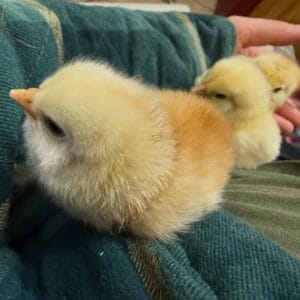
We actually don’t have to speculate too much about that first generation anymore – our first eggs hatched yesterday.
Four chicks total, and a better start than we expected.
All four appear to have pea combs. That’s a great early sign. Pea comb is dominant over single comb, so with a pea-combed father over single-combed Orpington hens, we expected to see it show up in a good portion of the hatch – but getting it on every chick in this first group is encouraging. It suggests our rooster may be homozygous for pea comb, which would mean he passes it consistently. We’ll know more as we hatch more eggs.
Three out of four have noticeably nice muffs and beards already. That’s genuinely exciting. Muffs and beard are also dominant, but the strength and quality of them this early – on chicks that are half Orpington – is a better result than we were bracing for. One chick came out clean-faced, which is completely expected and tells us our rooster is likely heterozygous for the muff/beard gene rather than carrying two copies.
Color is, as predicted, all over the place. We’re not reading into it yet.
Four chicks is obviously a very small sample size and we’re not drawing any big conclusions. But it’s a good start, and we’ll take it.
Future Generations: What We’re Working Toward
From F1, we’ll select the best offspring and breed back to quality Ameraucana stock – additional Blue Wheaten or Wheaten males, and true Buff Ameraucana genetics if good large fowl birds become available to integrate along the way. Each generation gets evaluated for type, color, and trait refinement before anything is kept back for breeding.
The long-term goals:
Color
A rich, even, warm buff throughout – no black ticking, no fading, no washed-out dilution. In males, the pattern should show cleanly with warm buff and gold expressing consistently from hackle to tail. In females, smooth and even across the body. We want birds that look like they belong in the standard.
Type
True Ameraucana type: full muffs and beard, pea comb, curved beak, slate legs, proper tail angle at 45 degrees above horizontal, prominent breast. The Orpington influence will add size and substance that we actually want to hold onto – but it’ll need to be refined over generations to bring body structure fully back to Ameraucana standard. No single combs, no bare faces, no yellow legs. Those are non-negotiable.
Egg Color
Blue. That’s the whole point. We’ll track egg color carefully across every generation and select from confirmed blue layers wherever possible. Green-eggers get noted and evaluated – they have their place in other projects, but not this pen.
Feather Quality
Dense, clean, well-structured feathering – no fraying, no breakdown. Which is exactly why keeping the lavender gene out from the very start matters. We want birds that look as good in July as they do in January.
We’re Not the Only Ones Figuring This Out
One of the things that’s kept us encouraged through the planning stages of this project is knowing we’re not doing it in a vacuum.
John McDermott up in Minnesota is working on something similar and seeing some really promising early results. It’s genuinely exciting to watch, and we’re following along closely. And Kyle Porosky is doing comparable work on the bantam side with Brown Red Ameraucanas – another absolutely gorgeous variety that deserves more people putting serious effort into it. These kinds of parallel projects are great for the breed overall – more people experimenting means more data on what works and what doesn’t.
On the other side of the coin, Juliane Kendall at Ballymoss Farm ran into a real issue with Wheaten in her own Buff project – specifically, birds washing out to white. That’s a known risk with certain Wheaten lines, where color modifiers don’t behave the way you’d hope and you end up with birds that are too pale to be useful. Because of that, she made the call to run Blacks instead, accepting the longer road back through dominant black expression in exchange for cleaner color control.
She’s also generously offered to share some of her birds with us to add to our line, if her next hatch grows out well. That kind of collaboration is exactly what makes these long projects feel less like a slog – and it could give us a really interesting genetic angle to work with down the road.
Is she right? Is Mike right? Are we right?
Honestly, probably all of us – for our own situations and the stock we have access to. That’s the nature of a project like this. There’s no single correct answer, and anyone who tells you otherwise hasn’t spent enough time in a breeding pen.
It’s trial and error. You make the best decision you can with the birds in front of you, document everything, and adjust as you go.
That’s exactly what we’re doing.
We’ll be posting updates as each generation comes along: what we’re seeing, what we’re keeping, what we’re culling, and where we’re headed. If you’re working on a similar project or have large fowl Buff Ameraucana experience to share, we’d love to hear from you!
More updates as the chicks grow out.