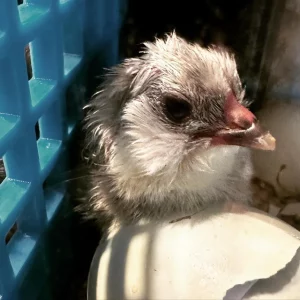
Ameraucana Chickens

Ameraucanas are a true American breed known for fluffy cheeks, pea combs, and blue eggs. On our farm, we focus on breed-correct type, steady temperaments, and clean, consistent egg color.

Quick Facts

Eggs: Ameraucanas are recognized for laying blue eggs, a defining breed trait retained from their Araucana ancestry. Heritage breed references typically describe production at around 180 to 220 eggs per year under standard conditions, with some well-managed flocks producing more. Eggs are usually medium, sometimes medium-large in mature hens.

Weight: According to the APA Standard of Perfection, standard Ameraucana hens weigh approximately 5.5 lb and roosters about 6.5 lb. Our Ameraucanas are large fowl (LF), not bantams. Bantam varieties are proportionally smaller.

Cold Hardiness: Ameraucanas are generally considered cold hardy and adaptable. Their pea combs help reduce frostbite risk, and they tolerate cold climates well when provided with appropriate shelter and dry footing.

Heat Hardiness: Ameraucanas handle heat reasonably well when given shade, ventilation, and fresh water. Their moderate body size and pea comb help reduce heat stress compared to heavier breeds or those with large single combs.

Broodiness: Ameraucanas are not known for strong broodiness compared to many heritage breeds. Some hens will go broody occasionally, but most are considered infrequent or inconsistent sitters.

Confinement Tolerance: Ameraucanas are active foragers that do best with space. While they prefer free ranging, they generally tolerate confinement reasonably well when provided adequate room and enrichment.

Personality: Ameraucanas are typically calm, curious, and people friendly. They tend to be alert without being overly flighty and usually integrate well into mixed flocks.

Purpose: A dual purpose heritage breed valued for blue eggs, exhibition, and backyard flocks. Ameraucanas are commonly kept for egg color programs, breed preservation, and showing.

About Our Line

Unlike Easter Eggers that hatcheries often sell as Ameraucanas, these are the real deal. We love Ameraucanas for their fluffy cheeks, pea combs, and reliably blue eggs that range from deeper sky blue to paler shades depending on the bird and season.

We focus exclusively on large fowl (LF) Ameraucanas, not bantams, with an emphasis on standard type and consistency. In our breeding pens we prioritize Standard-correct type (muffs/beard, pea comb, slate legs, correct tail and body type), fertility/hatchability, and calm, flock-friendly temperaments.

We originally brought Ameraucanas into our program in 2022, starting with birds purchased directly from APA Grand Master Exhibitor Paul Smith. That foundation gave us strong, standard-correct type, solid feather quality, and consistency across generations.

In 2024, we intentionally added genetics from Rachel Heldermon to address a common challenge in Self-Blue and Black Ameraucanas – managing gold bleed-through. Rachel’s lines emphasize cleaner silver-based coloration, which helps reduce unwanted warm tones showing through in both Blacks and Self-Blues while maintaining correct Ameraucana structure.

Breeding Notes from Our Ameraucana Program

To preserve feather quality and long-term structural soundness, we intentionally rotate our Self-Blue (Lavender) Ameraucanas back to Black Ameraucanas every few generations. In those years, chicks may hatch as either Self-Blue or Black carriers of the lavender gene, typically in roughly a 50 percent split.

Structurally, most of our Ameraucanas are evaluating very close to the Standard of Perfection. The most common traits we continue to monitor in some Blacks and Self-Blues are gold bleed-through and, in a smaller number of Self-Blues, feather banding. Using mixed Black and Self-Blue pens and selectively line breeding only our best birds has helped us steadily reduce these traits over time.

Simple Logic: The Secret Backpack

Think of a Black “Split” Ameraucana like a kid wearing a black t-shirt but carrying a blue shirt in their backpack.

You can’t see the blue shirt (the lavender gene), but they have it! If they meet another kid with a blue shirt in their backpack, they can trade and make a kid who is actually wearing the blue shirt (a visual Lavender chick).

Looking ahead: We are actively interested in adding large fowl Buff Ameraucanas from strong, standard-focused lines. If you raise them and prioritize type and consistency, we would love to connect.

Interested in our Ameraucana chickens?

We offer limited, seasonal availability from our standard-focused Ameraucana breeding program.

Show Awards for Our Flock

2023 Brown County Fair – Open Poultry Show

Black Ameraucana Pullet – 2nd Place
Bred by us | Owned and shown by Ashley VandenBush

Self-Blue Ameraucana Pullet – 3rd Place
Bred by us | Owned and shown by Ashley VandenBush

Waffles and Miracle the Black and Self-Blue Ameraucana Pullets at 2023 Brown County Fair

(Photos courtesy of Ashley VandenBush)

Waffles and Miracle the Black and Self-Blue Ameraucana Pullets at 2023 Brown County Fair

Photos of Our Flock

Black and Self-Blue Ameraucana Chicks
Black Ameraucana Rooster
Self-Blue Ameraucana Rooster
Black Ameraucana Chick
Chantecler and Ameraucana Eggs
Self-Blue Ameraucana Hen
Self-Blue Ameraucana Pullet
Self-Blue and Black Ameraucana
Self-Blue Ameraucana Rooster
Ameraucana Eggs
Self-Blue Ameraucana Chick
Self-Blue Ameraucana Cockerel
Black Ameraucana Rooster
2024 Self-Blue Ameraucana Rooster
Self-Blue Ameraucana Rooster and Svart Hona Hens

History and Genetics

Ameraucana Chicken History

Ameraucanas are a standardized American breed developed in the United States in the late 20th century. The breed traces back to South American blue egg chickens (especially Araucana-type birds) and the wave of blue egg imports and look-alikes that showed up in North America in the mid 1900s.

People loved the blue eggs, but those early blue egg birds varied wildly in type, temperament, fertility, and consistency. Breeders who wanted a healthier, more predictable blue egg chicken began selecting hard for a consistent body type, beard and muffs, pea comb, slate legs, and dependable reproduction while keeping the blue egg trait. That practical, multi-generation selection is what created the Ameraucana as a true breed instead of a blue egg mix.

The Ameraucana was recognized by the American Poultry Association (APA) in 1984, and birds bred to the Standard of Perfection reproduce those defining traits consistently from one generation to the next.

Credit to the people who built the breed

Ameraucana exists because a group of breeders did the unglamorous work for years: selecting for type, documenting traits, organizing clubs, and pushing varieties through the formal Standard process. If you want the deep-history version with names and timelines, the Ameraucana breed clubs maintain some of the best primary-source writeups.

Two places we recommend starting:

For Self-Blue naming history and why people still argue about it, this is the classic reference:

Back to History & Genetics Contents ↑

What Makes an Ameraucana an Ameraucana?

In plain terms, an Ameraucana is not just a chicken that lays blue eggs. It is a breed with a defined standard. When you breed two standard-correct Ameraucanas together, you should get predictable offspring that look like Ameraucanas.

Common breed identifiers

  • Beard and muffs (full face cheeks)
  • Pea comb (helps reduce frostbite risk)
  • Slate legs
  • Blue eggs (shade varies, but should be blue)
  • Recognized color varieties with defined color requirements
  • No ear tufts (tufts are an Araucana trait and not part of Ameraucana)

Quick Standard reality check

  • Egg color: should be blue. Shade varies by bird, line, season, and lighting.
  • Leg color: slate is part of the breed look. Yellow or willow legs are a red flag.
  • Comb: pea comb is expected. Single comb is not an Ameraucana trait.
  • Face: beard and muffs should be present. Clean-faced blue egg birds are usually Easter Egger type.

That predictability is the whole point of a breed. It is also why hatchery Easter Eggers and true Ameraucanas are not the same thing, even if both can lay blue eggs.

Back to History & Genetics Contents ↑

Large Fowl vs Bantam Ameraucanas

Ameraucanas are recognized in both Large Fowl and Bantam forms, and this matters because people mix the two up constantly when talking about varieties, timelines, and availability.

Practical differences to know

  • Variety recognition timing can differ between Large Fowl and Bantams.
  • Line development history can differ, even when the variety name is the same.
  • Some color and feather-quality challenges show up differently in different populations and lines.

Throughout this page, we are referring to Large Fowl Ameraucanas unless we explicitly say Bantam.

Back to History & Genetics Contents ↑

Recognized Ameraucana Varieties

Ameraucanas are not a rainbow mix. In the APA Standard of Perfection, only specific color varieties are recognized, with defined color requirements. Those recognized varieties are one reason true Ameraucanas breed much more predictably than Easter Eggers.

Recognized varieties (overview)

  • Black
  • Blue
  • Blue Wheaten
  • Brown Red
  • Buff
  • Silver
  • Wheaten
  • White
  • Self-Blue

Variety recognition and timing can differ between Large Fowl and Bantams. For the official current list, refer to the APA Standard and breed org resources linked below.

Our Ameraucana varieties at JK Herd It All

Right now, our program is focused on Self-Blue (Lavender) and Black split-to-lavender birds. Black splits are not “random extras” in our flock. They are part of the plan, and they help us protect feather quality and structure while we select for correct Self-Blue color over time.

Why we keep Black split-to-lavender birds

Black splits are part of a long-term Self-Blue program, not “extra” birds. They let us keep selecting for correct Ameraucana type, feather quality, and structure while we build and maintain Self-Blue lines responsibly.

Buff is a future goal for us and we are actively searching for some.

Back to History & Genetics Contents ↑

Blue Egg Genetics

Ameraucanas lay blue eggs because they carry the blue egg trait (often called oocyan). The important detail is that blue pigment is deposited as the shell forms, so the shell is colored through, not just painted on the outside.

  • Shade varies: Blue can range from deeper sky-blue to lighter or mintier tones depending on the bird and line.
  • Feather color does not control egg color: Self-Blue is a feather color gene, not an egg color gene.
  • Blue is through-shell: A true blue egg has that same blue tone on the inside of the shell.

One common point of confusion is green or olive eggs. In mixed blue egg birds, green often happens when a bird has the blue egg trait plus genetics for brown pigment that adds a brown top coat over the blue base. That is common in Easter Eggers. In standard-bred Ameraucanas, the expectation is blue eggs, even though the exact shade can vary.

Real-world note: We select for blue eggs, but exact shade can vary by line, season, bloom, and lighting – photos can be misleading even when the egg is truly blue.

Back to History & Genetics Contents ↑

Araucana Tufts and Why They Matter

A lot of Ameraucana confusion traces back to Araucanas. Araucanas are also a blue egg breed, but they are defined by different traits, especially ear tufts (and in many standards, rumplessness).

The practical breeding point is that tufted genetics can be difficult to stabilize. The ear tuft gene is associated with reduced hatchability because embryos that inherit two copies of the tuft gene typically do not survive incubation. That challenge is one reason many breeders who wanted a dependable, standardized blue egg chicken selected for a different set of defining traits over time.

Ameraucanas were developed as a practical, standardized blue egg breed with consistent type and better overall breedability, without relying on tufted genetics as a defining feature.

Back to History & Genetics Contents ↑

Black Ameraucana – A Foundational Variety

Black is one of the foundational Ameraucana varieties and remains one of the most useful colors in real breeding programs. In many lines, black birds are where you go to reinforce consistent type, feather quality, and overall breed stability.

Black is also extremely practical in Self-Blue programs. Even when you love lavender color, you still have to protect things like tail quality, wing strength, and overall feather structure. This is why you will see serious breeders intentionally working with black splits alongside Self-Blue rather than running a closed lavender-only flock forever.

Back to History & Genetics Contents ↑

About the Self-Blue (Lavender) Ameraucana Variety

The Self-Blue Ameraucana, often called Lavender, gets its soft, uniform pale blue-gray feather color from a recessive dilution gene commonly written as lav. Because it is recessive, chicks must inherit one copy from both parents to visually express self-blue.

Important note: Self-Blue refers to feather color only. Like all standard-bred Ameraucanas, Self-Blue birds should lay blue eggs.

One challenge breeders sometimes see in lavender-based varieties is weaker feather structure in some lines, especially tails and wing primaries. This is not automatic in all self-blue birds, but it is common enough that responsible programs select against it on purpose. Our own approach is simple: we do not chase color at the expense of long-term structure.

Common challenges in Self-Blue Ameraucana lines

  • Weaker feather structure in tails or wing primaries in some lines
  • Uneven or blotchy lavender tone when color is rushed
  • Soft feathering that sacrifices durability for appearance

These issues are not inevitable, but they do require intentional selection. We prioritize long-term structure and breed type first, and color second.

Self-Blue vs Lavender naming: yes, people still argue

This is where the “poultry people drama” lives. Genetically, the mutation is commonly referred to as lavender. In the Standard, the variety name is Self-Blue. Some breeders strongly prefer one term, some prefer the other, and the debate has been going on for years.

Our practical approach: we use Self-Blue when we are speaking Standard language, and we also say Lavender because that is the word most normal humans recognize.

Back to History & Genetics Contents ↑

Ameraucana Color Genetics – Quick Reference

This is a simplified overview of the color genetics questions we hear most often. These examples assume no additional modifying genes are present.

Self-Blue (Lavender)

  • Gene: recessive lavender (lav)
  • Breeds true: yes, when paired correctly
  • Lavender x Lavender: 100 percent lavender
  • Lavender x Black (lavender carrier): approximately 50 percent lavender and 50 percent black (lavender carriers)

Black (split to Lavender)

  • Visual color: black
  • Carries lavender: yes, one copy
  • Breeds true: no
  • Split x Split: approximately 25 percent lavender, 50 percent black splits, and 25 percent black non-carriers
  • Practical note: you cannot identify carriers by appearance alone, so test breeding is the usual check

Blue is not Self-Blue

  • Gene: dominant blue (Bl)
  • Breeds true: no
  • Blue x Blue: black, blue, and splash offspring
  • Not related to: lavender or self-blue genetics

Common misconceptions

  • Blue and Self-Blue are completely different genes.
  • Black splits cannot be identified by appearance alone.
  • Lavender requires two copies of the gene to be visible.
  • Egg color is not affected by feather color.

Back to History & Genetics Contents ↑

Origins of the Self-Blue (Lavender) Ameraucana

Self-Blue Ameraucanas are newer than the original recognized colors. They were developed through intentional breeding to introduce the lavender gene while keeping correct Ameraucana type front and center.

Multiple breeders worked on different foundation families over time, and you will sometimes see different details referenced depending on whether the discussion is Large Fowl, Bantam, or specific early lines. That is normal for newer varieties that were stabilized through multiple parallel projects rather than one single closed foundation flock.

If you want the deeper breeder-history and naming debate details from the community, this is a worthwhile read:

The Case for Lavender (PDF) ↗

Back to History & Genetics Contents ↑

Self-Blue in the APA Standard

Ameraucana entered the APA Standard of Perfection in 1984 with a defined standard and accepted varieties. Self-Blue was added later after years of stabilization work and the required qualifying meets, which helps explain why it is “newer” and why line consistency varies so much between sources.

This is also why we do not treat Self-Blue like a shortcut color. The best Self-Blue programs are standards-first and patient.

Back to History & Genetics Contents ↑

Ameraucana vs Easter Egger: The Cheat Sheet

This mix-up happens constantly. Here is the quickest way to tell them apart:

FeatureTrue AmeraucanaEaster Egger
Egg ColorBlue (Consistent)Blue, Green, Pink, or Brown (Variable)
Breeds True?Yes. Chicks look like parents.No. Chicks are a mix of traits.
Leg ColorSlate BlueGreen, Yellow, or Willow
RecognitionAPA Recognized BreedMixed Breed / Hybrid
Typical SourceBreeders & Specialty LinesFarm Stores & Large Hatcheries

Kind but firm truth: We’re not saying Easter Eggers are bad chickens – they’re wonderful pets! They just aren’t Ameraucanas, and they won’t reproduce a consistent look generation after generation.

Ameraucana FAQ

Do all Ameraucanas lay blue eggs?

Ameraucanas bred to the standard should lay blue eggs, though the exact shade can vary by bird and line.

Does self-blue mean the eggs are lighter?

No. Self-Blue refers to feather color, not egg color.

Are Ameraucanas the same as Araucanas?

No. Both can lay blue eggs, but they are different breeds with different standards. Araucanas are known for ear tufts, while Ameraucanas are defined by beard and muffs.

Why do hatcheries call them Ameraucanas?

Many hatcheries use the name for Easter Eggers. Ameraucanas are a standardized breed with defined traits and consistent breeding outcomes.

Do Ameraucanas lay in winter?

Like most chickens, laying usually slows when daylight is short. That is normal and not specific to Ameraucanas.

Do Ameraucanas need special feed?

Not special, but good nutrition matters. During growth, feathering, and active laying, adequate protein helps support body condition and feather quality. For our exact approach, see our Chick Care & Feeding Guide.

Back to History & Genetics Contents ↑

Comparing breeds?

  • Looking for consistent brown eggs? See our Buckeyes.
  • Want a rare, all-black bird with a wilder personality? Meet the Svart Hona.

References & Further Reading

If you want the longer history, breeder notes, and primary-source discussions (including the Self-Blue vs Lavender naming debate), these are solid starting points:

Associations & Breed Clubs

For breed standards, variety details, and breeder education, we recommend these organizations:

Want to learn more about raising Ameraucanas?

Our care guides reflect how we raise and manage our own birds, from brooding through adulthood.