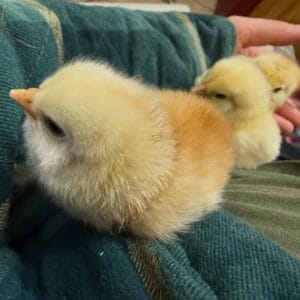
If your chickens still aren’t laying eggs and it’s almost April, you’re (probably) not doing anything wrong.
We’re seeing the same thing here in Mishicot, Wisconsin. Our Buckeyes and Pilgrim geese are already laying really well, while several of our other chicken breeds are still acting like winter never ended.
And honestly… that’s pretty normal for spring egg production around here.
If you’ve been wondering why your chickens aren’t laying yet, or why chickens seem to stop laying in winter and take forever to start again, there are a few big factors at play.
Spring doesn’t arrive all at once in Wisconsin
Even though the calendar says spring, the weather doesn’t always agree. Around here, we’re still dealing with cold nights, snow, wind, rain, and those in-between days that can’t decide what season they belong to.
That matters more than people think. Chickens respond to what they’re actually experiencing, not just the date on the calendar. If it still feels like winter, a lot of them will keep acting like it, which slows down egg production.
Daylight is increasing, but it’s not an instant switch
One of the biggest reasons chickens stop laying in winter is the lack of daylight. As the days get longer, hens naturally begin to come back into production.
But it doesn’t happen overnight.
Some birds respond quickly to increasing light. Others take their time, especially when the weather is still inconsistent. Until we get longer, more stable spring days, it’s completely normal to see uneven egg production across a flock.
Why our Buckeyes and Pilgrim geese are already laying
Our Buckeyes and Pilgrim geese are doing exactly what we want out of a practical, production-based flock.
They’re steady, cold-hardy, and not nearly as bothered by the ups and downs of late winter. While some of our other breeds are still waiting for nicer weather, these ones are already back to work.
That kind of reliability matters a lot when you’re dealing with unpredictable spring conditions.
Age plays a bigger role than most people realize
Another big reason chickens aren’t laying as quickly in the spring is age.
A lot of flocks are made up mostly of first-year layers, because it’s common to rotate hens out pretty quickly to keep egg production high. That works if your goal is maximum short-term output.
That’s not really what we’re aiming for.
We keep our hens longer, which means we have birds that are 2, 3, even 4+ years old still in the flock. They absolutely still lay, but they’re often slower to ramp back up after winter compared to younger hens.
We’re (slowly) selecting for longer-term egg production
One of our long-term goals is to build a flock that lays well over time, not just in that first big pullet year.
So instead of only hatching from our youngest or highest-producing hens, we’re also watching the older ones closely.
If a hen is still laying well at 3 or 4 years old, that matters to us. Those are the birds we want more of.
It’s definitely a slower approach, and it means spring egg production doesn’t always look perfect. But over time, it helps build a more durable, resilient flock.
So why aren’t your chickens laying yet?
In most cases, it comes down to a mix of:
- Lingering winter weather
- Not quite enough consistent daylight yet
- Breed differences
- Age of your hens
If your birds are healthy, eating well, and starting to perk up, they’ll come back into production as conditions settle.
What we’re seeing right now
Right now, our Buckeyes and Pilgrim geese are leading the charge, while the rest of the flock is taking their time. And honestly, that’s exactly what we’d expect for a mixed-age flock in northeastern Wisconsin.
The ones that come back strong and keep laying over time are the ones we pay the most attention to.
Those are the birds that shape the future of the flock.